


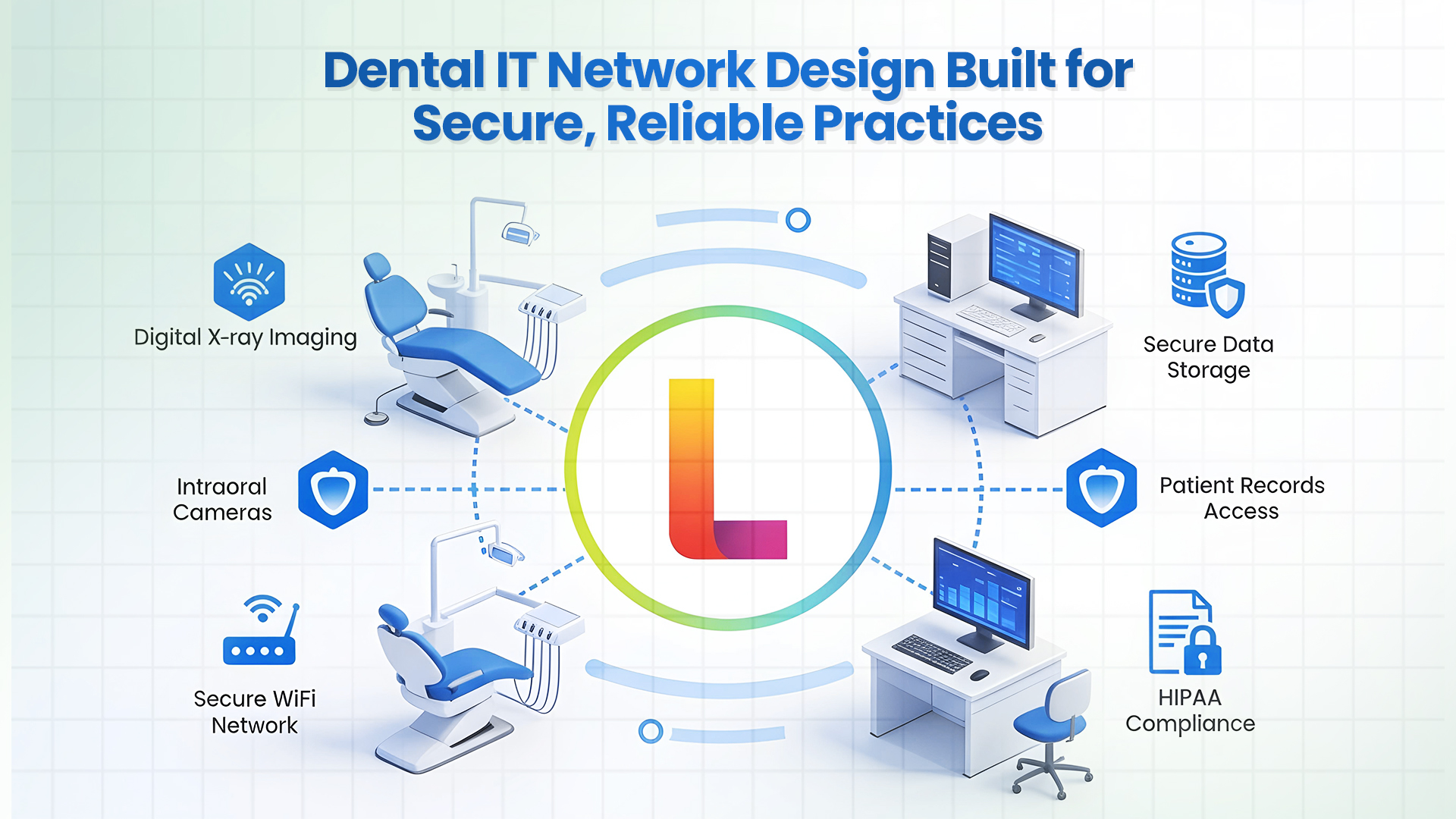
A dental environment has more than just the network design of interconnecting computers and devices. It has to do with establishing a stable and secure background that helps in patient care, clinical workflows, and regulatory compliance. In the event that a dental network is not properly designed, all the systems associated with it are at a risk.
Dental organizations that are dependent on technology require systems for operations and to capture images, appointments, practice management and security of patient information. Network design is a clinical support decision rather than an IT job in a healthcare environment.
This article describes the application of professional IT network design to dental practices, the significance of planning, and the safety of network design and implementation of dental practices in the long run.
What Network Design Means in a Dental IT Environment
Dental IT network design refers to the procedure of organizing the communication of systems, devices, and data throughout the practice. These include workstations, imaging tools, servers, cloud services and security controls.
A designed dental network guarantees effective access to charts, pictures and scheduling networks. An ill-implemented one introduces slowness, unavailability and vulnerability.
Dental network design is a strategic decision over healthcare infrastructure.
Why Dental Network Design Is a High-Risk Decision
Dental practices deal with protected health information (PHI) on a daily basis. The NIST Cybersecurity Framework recognizes secure system architecture as one of the fundamental requirements of risk management. One of the architectural components is network design.
The failure of the dental networks goes beyond IT.

Network Design vs. Network Setup in Dental Offices
The network setup and network design are terms used in many dental practices as synonymous, and they are quite different in the way they work towards the creation of the IT infrastructure. The knowledge of the distinction is essential to dental settings where imaging and practice management software as well as patient information should be accessible and safe during working hours.
Network installation is concerned with the installation of the equipment like switches, routers and access points. It aims at fundamental connectivity- ensuring the presence of communication between devices. Set-up is required, but does not take into account performance under clinical load, security measures or long-term stability.
Network design, conversely, is planning. It determines the reason the systems are interconnected, the flow of data between clinical tools and administrative tools, and the safeguards that are necessary to protect patient data. This planning has a direct impact on imaging speed or system uptime and compliance in the dental practice.
Office network Professional office network design is based on actual clinical use and not guesses. It predicts maximum imaging load, decouples sensitive systems and non-critical traffic, and establishes backup capacity to eliminate downtimes. In the absence of this planning, setup can be reactive, whereby issues are fixed once they interrupt patient care.
| Area | Network Setup | Network Design |
|---|---|---|
| Primary Focus | Hardware installation and connectivity | Architecture, data flow, and risk control |
| Clinical Performance | Reactive to slow imaging | Planned for peak imaging usage |
| Security | Added after issues arise | Built into the network from the start |
| Access Control | General network access | Role-based and system-specific access |
| Segmentation | Flat network | Separation of clinical, admin, and guest systems |
| Redundancy | Rarely included | Designed failover and continuity |
| Compliance Support | Limited | Supports HIPAA technical safeguards |
| Long-Term Reliability | Short-term | Built for growth and stability |
Column
$ 99
Per MonthColumn
$ 99
Per Month Core Principles of Effective Dental IT Network Design
All dependable dental networks adhere to the same principles.
Performance Comes First
Dental imaging and charting systems require a regular pace of work in the clinic.
Security by Design
The network must be constructed to have firewalls, access controls, and segmentation.
Scalability
The dental networks should be able to facilitate growth without interfering in the care of patients.
Visibility
Administrators must have a clear understanding of what is going on in the network to be able to detect problems at an early stage.
Network Design and Dental Compliance Responsibilities
Dental practices must design networks that support healthcare compliance requirements.
The HIPAA Security Rule mandates technical safeguards of the electronic patient information. Access management, monitoring and segmentation are network controls directly associated with these safeguards.
Policies in themselves do not lead to compliance. It is imposed by design.
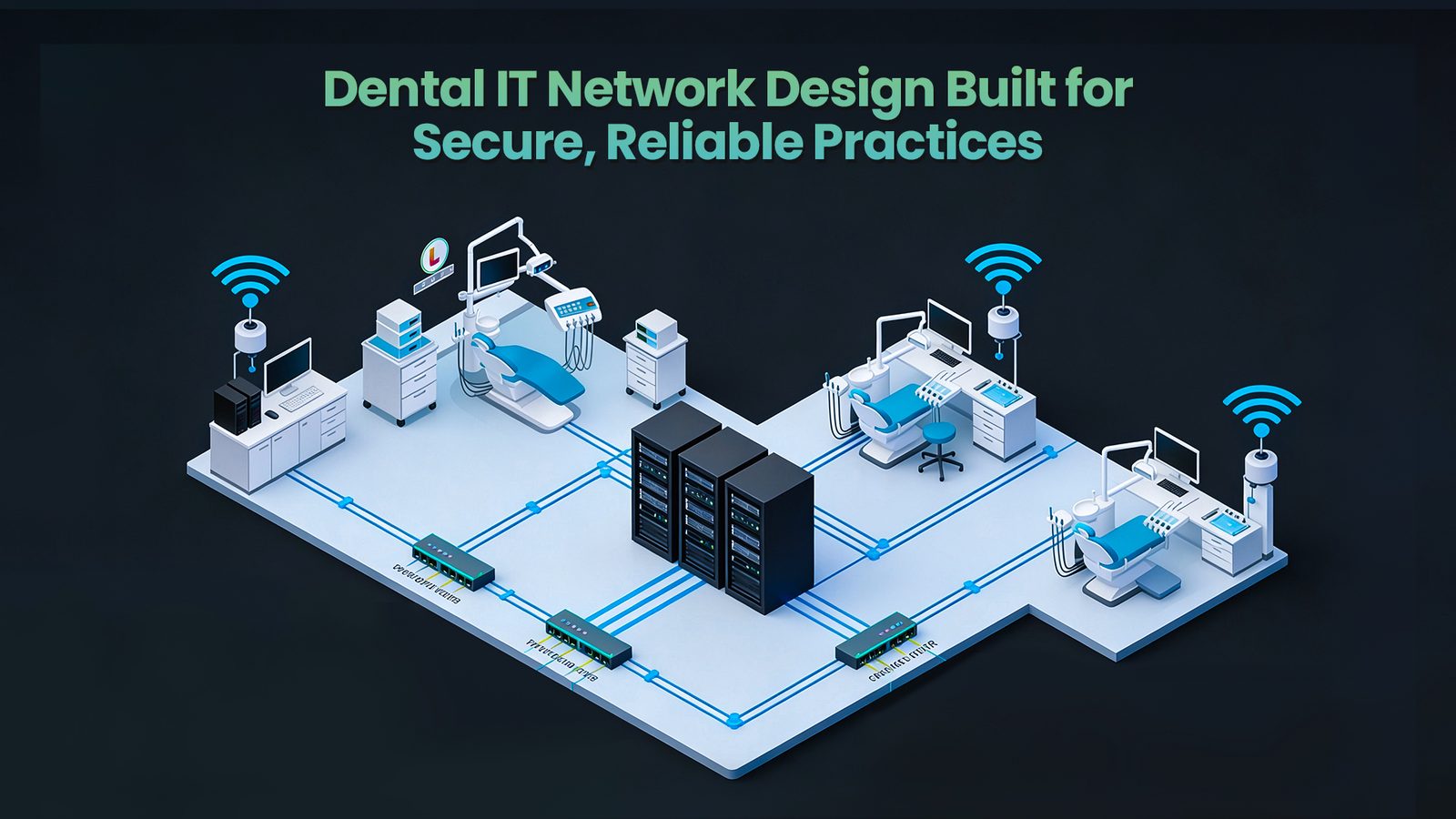
Modern Dental Workflow Office Network Design
The current dental practice is based on the cloud platform, digital imaging, and hybrid work patterns.
Successful design of the office network is supportive of:
- Secure cloud connectivity
- Operation room imaging systems.
- VoIP and communication instruments with patients.
- Unnecessary internet connections.
We build dental networks based on the real functioning of the teams rather than on idealized diagrams.
The Role of Network Segmentation in Dental IT
One of the least considered aspects of dental IT network design is network segmentation.
Segmentation restricts the communication between systems that minimizes the diffusion of security incidents and isolates sensitive clinical systems. It is also effective in enhancing workflow because the imaging traffic is no longer coupled with administrative activities.
This method is in line with CISA guidance on the best practices to network security which focuses on curbing the lateral movement within the networks.
The contemporary dental setting places great emphasis on segmentation.
How Legend Networking Approaches Dental IT Network Design
At Legend Networking, dental network design is considered as a long term investment in patient care, as well as stability in operations.
We combine technical expertise with an understanding of dental workflows. Every environment is assessed individually, not copied from templates.
We aim at reliability, security and accountability.
Network Design and Implementation: Why Planning is The First Thing
Design should be always followed by implementation. Before deployment, we assess:
- Current dental IT infrastructure.
- Dependencies Imaging and software.
- User access requirements
- Growth and redundancy needs
At the planning stage only do we proceed to implementation. This helps to avoid interruption and re-work.
Network Design for Multi-Location Dental Practices
As dental practices add locations, network complexity increases.
Multi-location environments require consistent security policies, centralized visibility, and reliable inter-office connectivity. Without proper design, performance and compliance suffer.
Our network architecture helps in the expansion of dental collectives with scalable and consistent architecture
Local Dental IT Network Design Expertise Across the United States of America
We provide location-specific dental IT solutions while maintaining consistent network standards.
Dental practices benefit from:
- Austin dental office IT solutions supporting scalable network design
- Charlotte dental office IT solutions focused on secure connectivity
- Dallas dental office IT solutions optimized for performance and redundancy
- San Antonio dental office IT solutions built for reliability
- Raleigh dental office IT solutions aligned with long-term growth
- Philadelphia dental office IT solutions designed for compliance-driven environments
Local expertise improves response time without sacrificing architectural consistency.
Common Dental Network Design Mistakes We See
Hardware is not a cause of most network failures.
We frequently see:
- Segmentation-free flat networks.
- Undersized firewalls
- None of the failover strategies were documented.
- Networks constructed informally.
These problems can be avoided during design.
Why Dental Network Design Is a Leadership Decision
Patient data protection, uptime, and compliance will be influenced by dental IT network design. It is one leadership role, not necessarily an IT activity.
The administrators and the owners of the practice need to know how their networks are safeguarding the provision of care. Oversight matters.
Equipment is as important as documentation and transparency.
Professional Dental Network Design: The Long-Term Value.
Developed dental networks save time, minimize burden, and decrease final expenses. They also upgrade and expand them in less disruptive ways.
Early investment practices in terms of network design and implementation prevent later repeated fixes.
It is experience not theory.
Final Thoughts
Strong dental networks are built deliberately, not accidentally.
The terms network setup and network design are confusingly used by many dental practices, though they are quite different in the context of development of IT infrastructure. The distinction between the two is important in the dental setting where imaging apparatus and practice management software should be accessible and safe all day long.
Network installation majors on the installation of equipment like switches, routers, and access points. It aims at fundamental connectivity, namely, ensuring that devices communicate. Although it is needed, the setup does not provide performance under clinical load, security controls, or long-term reliability.
Network design, however, is a type of planning. It clarifies the reasons behind connecting as well as the movement of data in between clinical and administrative tools, and what security measures are necessary to secure patient information. This planning has a direct impact on the speed of imaging, the uptime of the systems, and their compliance in dental practices.
Real clinical use is also taken into consideration in professional office network design, and not assumptions. It envisages the highest level of imaging load, segregates sensitive systems, and general traffic, and provides redundancy to avoid any downtime. In the absence of this planning, the setup tends to be reactive, i.e. things are only fixed when they are causing disruption to patient care.
Frequently Asked Questions
Q. What is dental IT network design?
Ans. Dental IT network design refers to the logical planning of the connections between clinical systems, administrative systems and cloud systems in a dental practice in a way that is secure and efficient.
Q. What is the value of professional IT network design to dental offices?
Ans. Professional design also saves time, enhances security, and assists in meeting HIPAA, and also allows networks to scale without interruptions in the care provided to patients.
Q. What are the impacts of network design on HIPAA compliance?
Ans. Network architecture directly facilitates access control requirements, monitoring, and data protection requirements as defined by HIPAA Security Rule.
Q. What does network design & implementation entail?
Ans. It is composed of evaluation and architecture design, security design, deployment, documentation, and continuous optimization.






 Based in USA

