

Technology has become the backbone of every modern dental practice. From electronic health records (EHR) and digital imaging systems to appointment scheduling, billing platforms, cloud applications, and cybersecurity tools, every aspect of patient care depends on reliable IT infrastructure.
Without proactive IT management, even a minor technical issue can interrupt patient appointments, delay treatment, create compliance risks, and negatively affect the patient experience.
Managed IT services for dental practices provide ongoing monitoring, cybersecurity protection, technical support, cloud management, backup solutions, and strategic IT planning. Rather than reacting to problems after they occur, a managed IT provider helps prevent downtime before it impacts your practice.
Whether you’re opening your first dental office, expanding to multiple locations, or replacing your current IT provider, this buyer’s guide explains everything you need to know about choosing the right dental managed IT partner while improving security, compliance, and long-term business performance.
Quick Answer
Managed IT services for dental practices provide proactive monitoring, cybersecurity, HIPAA compliance support, cloud management, data backup, help desk services, network maintenance, and strategic IT planning for a predictable monthly cost. A qualified dental IT provider helps practices reduce downtime, improve patient care, strengthen cybersecurity, and keep critical systems running efficiently. For most practices, outsourcing IT is more cost-effective than hiring a full in-house team.
Key Takeaways
- Dental managed IT reduces downtime through proactive monitoring and maintenance.
- A specialized dental IT provider understands dental software, imaging systems, HIPAA requirements, and clinical workflows.
- Outsourced dental IT often costs less than maintaining an internal IT department.
- Cybersecurity protection is now an essential part of managed IT services due to increasing ransomware attacks targeting healthcare.
- Regular backups, disaster recovery planning, and 24/7 monitoring help protect patient data.
- Choosing an experienced Managed Service Provider (MSP) improves productivity while reducing long-term technology costs.
- Strategic IT planning helps dental practices scale with confidence.
Why Managed IT Services Matter for Dental Practices
Modern dental practices rely on interconnected technology throughout the entire patient journey. Scheduling software, treatment planning, digital X-rays, intraoral scanners, insurance verification, payment processing, and communication platforms all depend on secure and reliable IT systems.
When those systems fail, the impact is immediate.
Appointments may need to be cancelled. Staff productivity declines. Providers lose access to patient records. Billing delays affect cash flow, while cybersecurity incidents can expose sensitive health information and trigger regulatory consequences.
Managed IT services address these challenges through continuous monitoring, preventative maintenance, and rapid technical support. Instead of waiting for problems to occur, your IT provider actively identifies risks before they disrupt your business.
This proactive approach not only reduces downtime but also allows dentists and staff to focus on delivering exceptional patient care instead of troubleshooting technology.
What Are Managed IT Services for Dental Practices?
Managed IT services refer to the ongoing management, monitoring, maintenance, and support of a dental practice’s technology infrastructure by an external technology partner, commonly known as a Managed Service Provider (MSP).
Unlike traditional break-fix IT support, where businesses only call for help after something breaks, a dental MSP works proactively to prevent issues before they occur.
Typical managed IT services include:
- 24/7 network monitoring
- Help desk support
- Server management
- Cloud services
- Microsoft 365 management
- Endpoint protection
- Firewall management
- Email security
- Backup and disaster recovery
- HIPAA compliance support
- Hardware lifecycle planning
- Software updates and patch management
- Vendor coordination
- Strategic technology consulting
The goal is to create a stable, secure, and scalable IT environment that supports both clinical operations and business growth.
Signs Your Dental Practice Needs Managed IT Services
Many practices don’t realize they need professional IT support until a major disruption occurs.
If your practice experiences any of the following issues regularly, it may be time to evaluate outsourced dental IT.
Frequent Downtime
If computers, servers, or internet connections frequently interrupt patient appointments, productivity suffers, and patient satisfaction declines.
Slow Computer Performance
Outdated hardware, poor network configuration, and neglected maintenance often cause unnecessary delays throughout the workday.
Increasing Cybersecurity Threats
Healthcare remains one of the most targeted industries for ransomware and phishing attacks. Without continuous monitoring, practices become increasingly vulnerable.
According to the U.S. Department of Health and Human Services (HHS) and the Cybersecurity & Infrastructure Security Agency (CISA), healthcare organizations continue to face growing cyber threats, making proactive cybersecurity a critical component of modern healthcare operations.
Compliance Concerns
HIPAA requires dental practices to implement administrative, physical, and technical safeguards to protect electronic protected health information (ePHI).
An experienced dental IT provider helps implement security controls that support compliance while reducing operational risk.
Unpredictable IT Expenses
Emergency repairs often cost significantly more than ongoing proactive maintenance.
Managed IT replaces unpredictable repair bills with consistent monthly pricing and long-term technology planning.
Break-Fix IT vs Managed IT Services
| Feature | Break-Fix IT | Managed IT Services |
| Support Model | Reactive | Proactive |
| Monthly Cost | Unpredictable | Predictable |
| Downtime | Higher | Lower |
| Cybersecurity | Limited | Continuous |
| Monitoring | No | 24/7 |
| Backup Management | Optional | Included |
| Strategic Planning | Rare | Continuous |
| Compliance Assistance | Limited | Ongoing |
| Business Continuity | Minimal | Comprehensive |
For most modern dental practices, managed IT offers better long-term value by reducing downtime, improving security, and providing ongoing strategic support rather than simply responding to emergencies.
The Core Components of Dental Managed IT
A comprehensive managed IT solution should cover every critical aspect of your technology environment, not just technical support.
The following sections explain the essential services every dental practice should expect from a trusted dental MSP.
Essential Components of Managed IT Services for Dental Practices
Not every managed IT provider offers the same level of service. Some focus only on fixing computers, while others become long-term technology partners that help practices improve security, efficiency, compliance, and scalability.
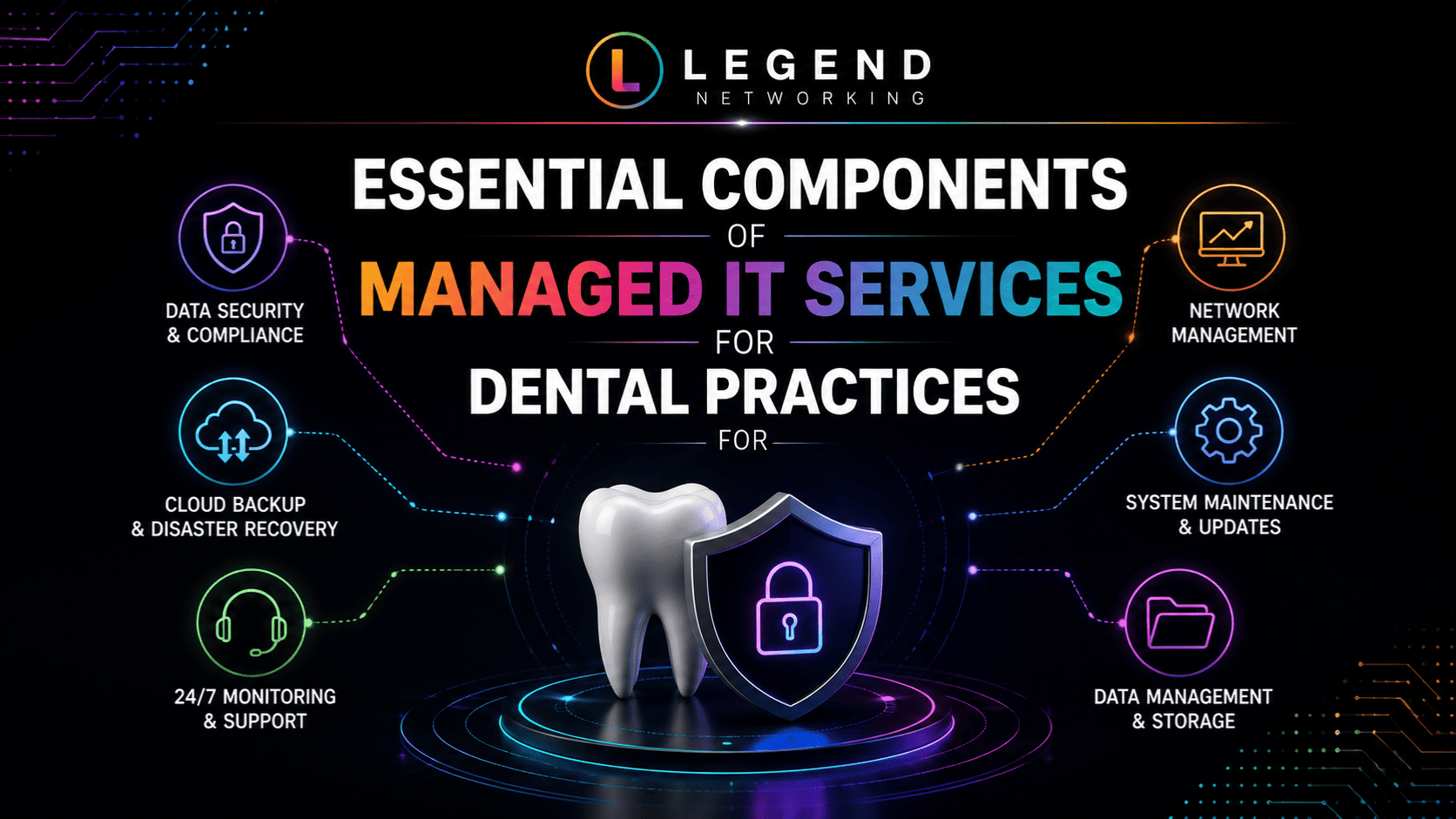
Below are the core services every dental practice should expect from a professional dental IT provider.
1. 24/7 Network Monitoring
Your dental office network supports nearly every business function, a professionally designed dental office network setup creates the foundation for reliable connectivity, faster performance, and secure communication throughout your practice from accessing patient records to submitting insurance claims.
Continuous monitoring helps detect problems before they affect daily operations, including:
- Server failures
- Internet outages
- Storage capacity issues
- Network congestion
- Suspicious login attempts
- Hardware failures
Instead of discovering issues after patients arrive, your Managed Service Provider (MSP) can often resolve them before staff even notice.
2. Help Desk & Remote Support
Technology issues are inevitable, but waiting hours or even days for assistance isn’t acceptable in a busy dental office.
An experienced dental MSP provides responsive support for:
- Password resets
- Printer issues
- Practice management software
- Email problems
- Microsoft 365
- Digital imaging software
- User account management
- Hardware troubleshooting
Fast support keeps appointments on schedule and minimizes workflow disruptions.
3. Cybersecurity Protection
Healthcare organizations continue to be among the most targeted industries for cybercrime because they store valuable patient and financial information.
A comprehensive cybersecurity strategy should include:
- Endpoint Detection & Response (EDR)
- Managed antivirus
- Multi-Factor Authentication (MFA)
- DNS filtering
- Email security
- Firewall management
- Security awareness training
- Vulnerability assessments
- Continuous threat monitoring
Rather than relying on a single antivirus solution, layered security significantly reduces overall risk.
4. Backup & Disaster Recovery
Every dental practice should prepare for unexpected events, including ransomware, hardware failures, accidental deletion, and natural disasters.
Reliable backup solutions should include:
- Automated backups
- Encrypted storage
- Cloud replication
- Local backup copies
- Disaster recovery planning
- Regular restoration testing
Following the widely recommended 3-2-1 Backup Rule, three copies of data, stored on two different media types, with one copy kept off-site, helps ensure business continuity.
5. Cloud Services
Cloud technology allows dental teams to work more efficiently while improving resilience and accessibility.
Common cloud services include:
- Microsoft 365
- Secure file sharing
- Cloud backup
- Virtual desktops
- Cloud-hosted servers
- Email hosting
- Remote access solutions
Cloud services also simplify expansion for practices opening additional locations. For practices upgrading conference rooms, training spaces, or patient education areas, professional audio video system integration helps create a more connected and collaborative environment.
6. HIPAA Compliance Support
HIPAA compliance is more than installing antivirus software.
A knowledgeable dental IT provider helps practices implement technical safeguards that support regulatory requirements, including:
- Encryption
- Access controls
- Audit logging
- Backup management
- Device security
- Risk assessments
- User authentication
- Security policies
While no IT provider can certify HIPAA compliance on behalf of a practice, they play an essential role in supporting a compliant technology environment.
Why Dental Practices Choose Outsourced IT
Hiring an internal IT employee can be expensive, particularly for small and mid-sized dental practices.
Outsourced Dental IT provides access to an entire team of specialists without the overhead associated with recruiting, training, salaries, and ongoing certifications.
Benefits include:
- Lower operating costs
- Access to multiple IT specialists
- Faster response times
- Proactive maintenance
- Predictable monthly pricing
- Strategic technology planning
- Improved cybersecurity
- Vendor management
- Scalable support as the practice grows
Many practices discover that outsourcing delivers broader expertise than relying on a single in-house technician.
In-House IT vs Outsourced Dental IT
| Feature | In-House IT | Outsourced Dental IT |
| Staffing Cost | High | Predictable Monthly Fee |
| Expertise | Limited to One Employee | Team of Specialists |
| Vacation Coverage | Limited | Always Available |
| Cybersecurity | Depends on Experience | Dedicated Security Experts |
| Monitoring | Varies | 24/7 Monitoring |
| Compliance Support | Limited | Healthcare-Focused |
| Scalability | Difficult | Easy |
| Strategic Planning | Limited | Ongoing |
For most single-location and multi-location dental practices, outsourced IT delivers greater flexibility and a stronger return on investment.
How to Choose the Right Dental IT Provider
Selecting an IT provider shouldn’t be based solely on price. The right partner understands both technology and the operational realities of a dental practice.
When evaluating providers, ask the following questions:
Do they specialize in dental practices?
Dental offices rely on unique technologies, including:
- Dentrix
- Eaglesoft
- Open Dental
- Carestream
- Dexis
- CBCT systems
- Digital imaging platforms
- Intraoral scanners
Industry experience reduces implementation challenges and shortens resolution times.
Do they offer proactive monitoring?
A quality provider continuously monitors your environment rather than waiting for failures to occur.
What cybersecurity services are included?
Look for providers that include:
- Email protection
- Endpoint security
- Multi-Factor Authentication
- Backup monitoring
- Security awareness training
- Vulnerability management
Do they provide strategic IT planning?
Technology should support long-term business growth.
An experienced MSP helps plan:
- Hardware upgrades
- Office expansions
- Cloud migrations
- Budget forecasting
- Network modernization
Are response times guaranteed?
Request Service Level Agreements (SLAs) that define:
- Response time
- Resolution targets
- Escalation procedures
- Emergency support availability
Dental Managed IT Buyer’s Checklist
Use this checklist when comparing providers.
Experience
✔ Healthcare IT expertise
✔ Dental software knowledge
✔ HIPAA familiarity
✔ Client references
Security
✔ Managed firewall
✔ Endpoint protection
✔ Email filtering
✔ MFA implementation
✔ Security monitoring
✔ Vulnerability scanning
Business Continuity
✔ Cloud backup
✔ Local backup
✔ Disaster recovery planning
✔ Backup testing
✔ Business continuity strategy
Support
✔ Unlimited help desk
✔ Remote support
✔ On-site support
✔ 24/7 monitoring
✔ Vendor coordination
Strategy
✔ Technology roadmap
✔ Budget planning
✔ Hardware lifecycle management
✔ Cloud consulting
✔ Compliance guidance
Practical Example
A Growing Multi-Location Practice
A dental practice expanded from one office to three locations in less than two years.
Initially, each office managed its own computers, internet provider, backups, and security software independently. As the business grew, staff experienced inconsistent performance, duplicate software licensing, delayed support, and increasing cybersecurity risks.
After partnering with a dental managed IT provider, the practice centralized its network management, standardized hardware, implemented encrypted cloud backups, strengthened cybersecurity, and introduced proactive monitoring across all locations.
The result was a more reliable technology environment, improved collaboration between offices, fewer support interruptions, and greater confidence in protecting patient information.
How Much Do Managed IT Services for Dental Practices Cost?
The cost of managed IT services varies depending on the size of your practice, the number of users and devices, the complexity of your network, compliance requirements, and the level of support included.
Most Managed Service Providers (MSPs) offer predictable monthly pricing, making it easier to budget for IT expenses compared to unpredictable break-fix support.
Factors that influence pricing include:
- Number of employees and workstations
- Number of office locations
- Server infrastructure
- Cloud services
- Cybersecurity requirements
- Backup and disaster recovery
- After-hours support
- Compliance monitoring
- On-site service requirements
Instead of focusing solely on monthly cost, practices should evaluate the total value provided, including reduced downtime, stronger cybersecurity, improved productivity, and long-term technology planning.
Common Mistakes to Avoid When Choosing a Dental MSP
Selecting the wrong IT provider can create long-term operational and security challenges. Before signing a service agreement, be aware of these common mistakes.
Choosing Based Only on Price
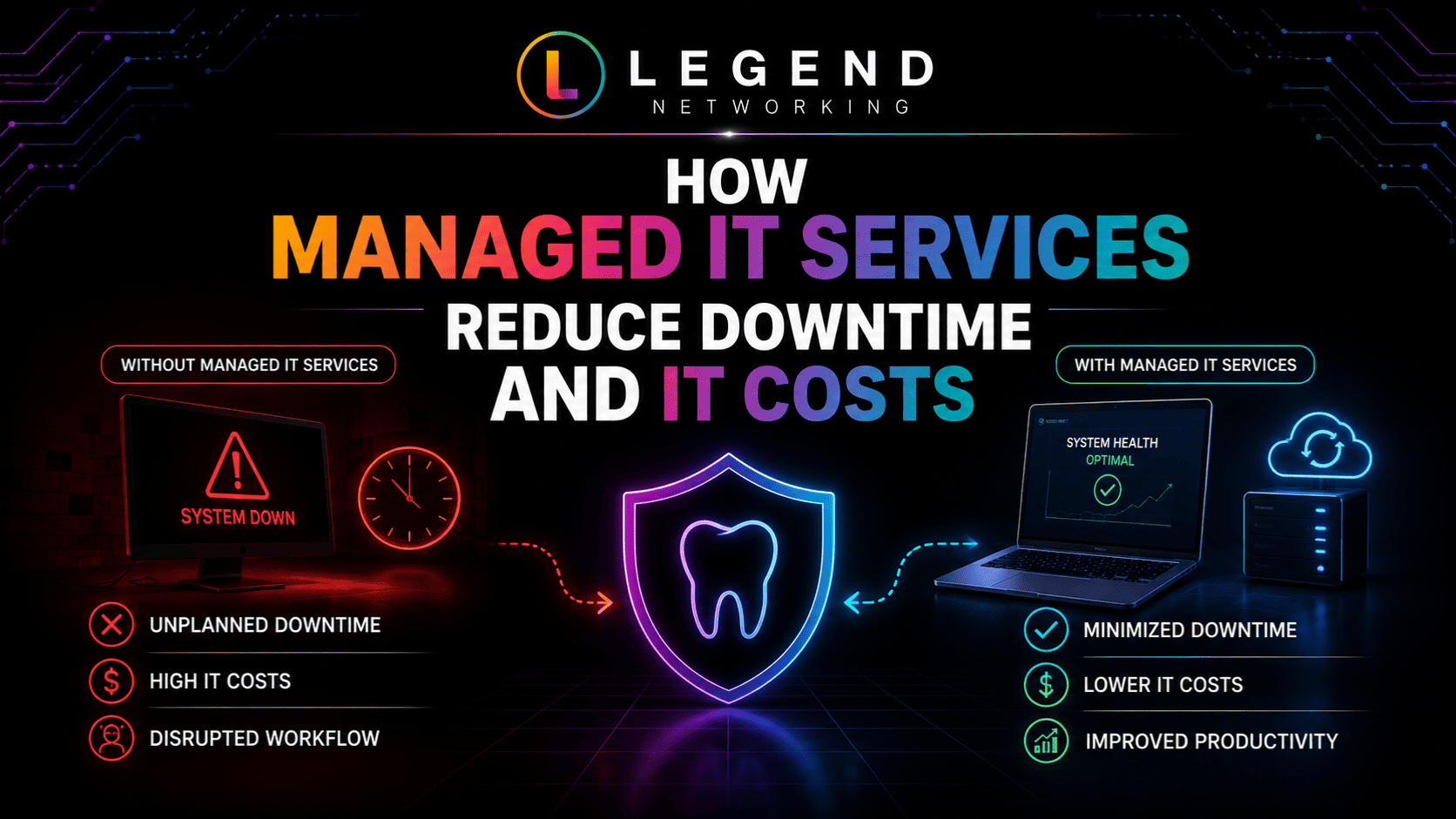
The lowest-priced provider may not offer proactive monitoring, cybersecurity, compliance support, or strategic planning. A lower monthly fee can lead to higher long-term costs through downtime, security incidents, and emergency repairs.
Hiring a General IT Company
Dental practices use specialized software, imaging systems, and workflows that general IT companies may not fully understand.
Working with a provider experienced in dental technology often leads to faster issue resolution and smoother system integrations.
Ignoring Cybersecurity
Cybersecurity should be a core component of every managed IT agreement—not an optional add-on.
Without layered security, practices face increased risks from ransomware, phishing, and unauthorized access.
Not Reviewing Service Level Agreements (SLAs)
Your service agreement should clearly define:
- Response times
- Resolution targets
- Emergency support availability
- On-site support policies
- Escalation procedures
- Included services
Understanding these expectations helps avoid surprises during critical situations.
Overlooking Scalability
Technology needs to change as practices grow. Choose a provider that can support:
- New office locations
- Additional employees
- Cloud migrations
- Equipment upgrades
- New dental technologies
A scalable IT partner helps your infrastructure evolve alongside your business.
Managed IT Evaluation Framework
When comparing providers, evaluate them across these key areas.
| Category | Questions to Ask |
| Experience | Do they specialize in dental IT? |
| Security | What cybersecurity protections are included? |
| Compliance | Do they support HIPAA security requirements? |
| Support | Is 24/7 monitoring included? |
| Backups | How are backups monitored and tested? |
| Strategy | Will they help with long-term IT planning? |
| Scalability | Can they support multiple locations? |
| Transparency | Are pricing and SLAs clearly documented? |
Using a structured evaluation process helps ensure you choose a long-term technology partner rather than simply an IT vendor.
Future Trends in Dental Managed IT
Technology continues to evolve, and managed IT providers play an important role in helping dental practices adopt new solutions safely and efficiently.
Key trends include:
- Cloud-first infrastructure
- Zero Trust security models
- Advanced endpoint protection
- Automated patch management
- Secure remote work solutions
- Microsoft 365 collaboration tools
- Business continuity planning
- Compliance-focused cybersecurity
- Centralized management for multi-location practices
Practices that modernize their IT environment today are better prepared for future growth and evolving security threats.
Why Partner with Legend Networking?
Technology should empower your dental practice, not slow it down.
Legend Networking provides managed IT services designed specifically for healthcare and dental organizations, helping practices strengthen cybersecurity, improve system reliability, and maintain business continuity.
Whether you need day-to-day IT support, cloud migration, disaster recovery planning, Microsoft 365 management, or cybersecurity improvements, partnering with an experienced provider gives your team the confidence to focus on delivering outstanding patient care.
Managed IT Readiness Checklist
Use this checklist to evaluate your current IT environment.
Infrastructure
☐ Network professionally managed
☐ Servers monitored
☐ Wi-Fi secured
☐ Hardware lifecycle documented
Cybersecurity
☐ Multi-Factor Authentication enabled
☐ Endpoint Detection & Response deployed
☐ Email security implemented
☐ Firewall monitored
☐ Security awareness training completed
Backup & Recovery
☐ Daily automated backups
☐ Cloud backup configured
☐ Local backup available
☐ Recovery testing completed
☐ Disaster recovery plan documented
Compliance
☐ User access controls reviewed
☐ Encryption enabled
☐ Audit logs maintained
☐ Risk assessments performed
☐ Policies updated regularly
Support
☐ Unlimited help desk
☐ Vendor management
☐ Strategic IT planning
☐ Quarterly technology reviews
Conclusion
Reliable technology is essential to delivering exceptional patient care. From appointment scheduling and digital imaging to cybersecurity and HIPAA compliance, every aspect of a modern dental practice depends on stable, secure, and well-managed IT systems.
Managed IT services provide more than technical support; they offer proactive maintenance, strategic planning, cybersecurity expertise, and business continuity solutions that help practices reduce downtime, protect sensitive patient information, and confidently plan for future growth.
Whether you’re evaluating your first Managed Service Provider or looking to replace an existing IT partner, choosing a provider with dental industry expertise can make a significant difference in operational efficiency, security, and long-term success.
Ready to Strengthen Your Practice’s IT?
Technology challenges shouldn’t interfere with patient care. Protect your practice with confidence. Explore our Google Business Profile to see why dental professionals choose Legend Networking.
Legend Networking helps dental practices build secure, reliable, and scalable IT environments through proactive managed services, cybersecurity solutions, cloud technologies, backup and disaster recovery, and ongoing strategic support.
Schedule a consultation with Legend Networking today to assess your current IT environment, reduce technology risks, and create a roadmap for a more secure and efficient dental practice.




 Based in USA

